WX Score: How It Works
Understand how PlaneWX calculates your score, what triggers an unfavorable status, and how your personal minimums shape the assessment.
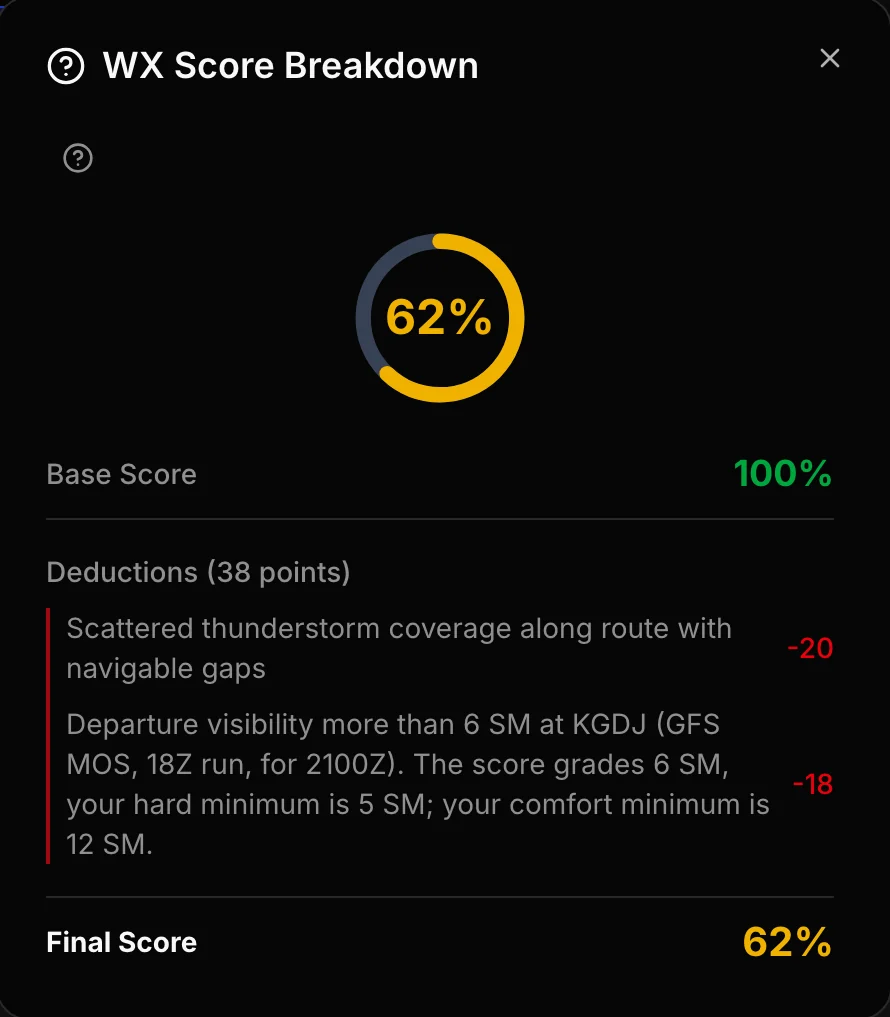
Overview
Your WX Score starts at 100 points and is reduced by deductions for weather conditions that don't meet your personal minimums and aircraft capabilities. It is not based on generic VFR/IFR standards. It reflects what matters for your flight, your aircraft, and your experience level.
Favorable (75 and up). Conditions meet your minimums. Plan confidently.
Marginal. Some conditions are close to your limits.
Unfavorable. Conditions exceed limits you set.
Automatic Unfavorable Conditions
Certain conditions are always unfavorable regardless of your score math. These are hazards that no personal minimums setting can mitigate:
Freezing Precipitation
- • Freezing rain (FZRA)
- • Freezing drizzle (FZDZ)
- • Freezing fog (FZFG)
- • Ice pellets (PL)
Unfavorable regardless of FIKI equipment
Convective Weather
- • Thunderstorms (TS, TSRA, TSGR)
- • Vicinity thunderstorms (VCTS)
- • Hail (GR)
- • Squalls (SQ)
Severe Hazards
- • Funnel cloud / tornado (FC)
- • Volcanic ash (VA)
- • Severe dust/sand storms (+DS, +SS)
Personal Limit Exceedances
- • Ceiling below your hard limit
- • Visibility below your hard limit
- • Crosswind exceeds your limit (all runways). From 12 to 72 hours out, an NBM and MOS crosswind over your limit is a 15 point caution, not a 0%
- • Icing exceeds your tolerance
- • Turbulence exceeds your tolerance
The 12-Hour Rule
PlaneWX treats flights differently based on how far out they are. TAFs (Terminal Aerodrome Forecasts) are highly reliable within 12 hours but become uncertain beyond that.
Within 12 Hours
- Server-side pre-flight check runs against TAF data
- Hard limit exceedances = 0% score
- Hazardous weather phenomena = 0% score
- Comfort/limit zones checked with graduated penalties
- Server handles turbulence, icing, crosswind, and wind shear scoring
Beyond 12 Hours
- Most pre-flight checks wait until inside 12 hours
- When a TAF covers departure or arrival (up to 24h), server still scores TAF wind shear and crosswind. A hard violation can be 0%, not the 25% floor
- A ceiling or visibility forecast wholly below your hard limit is a NO-GO and scores 0%, not the 25% floor, when the departure or arrival ceiling comes from a TAF, METAR, GFS MOS, NBM or the pre-flight check (whatever the source of the visibility value). For VFR this includes your departure or arrival visibility minimum when no visibility comfort or limit value is set. When the ceiling at both airports comes from none of those sources (for example a model estimate), the 25% floor applies. En-route smoke below your visibility hard limit also scores 0%
- Otherwise no automatic 0%. Minimum floor of 25%
- Forecasts are uncertain. Conditions may improve
- Briefing auto-refreshes and re-scores as departure approaches
- AI scores icing and turbulence based on your personal limits
Why 25% and not 0%? Forecasts more than 12 hours out are based on models (GFS, NBM) and area forecasts (AFDs), which are less precise than TAFs. A 0% score would suggest certainty that doesn't exist. The 25% floor signals "unfavorable but uncertain" (except when a covering TAF already names wind shear or crosswind over your limits). Your briefing will automatically re-score with more accurate data as departure approaches.
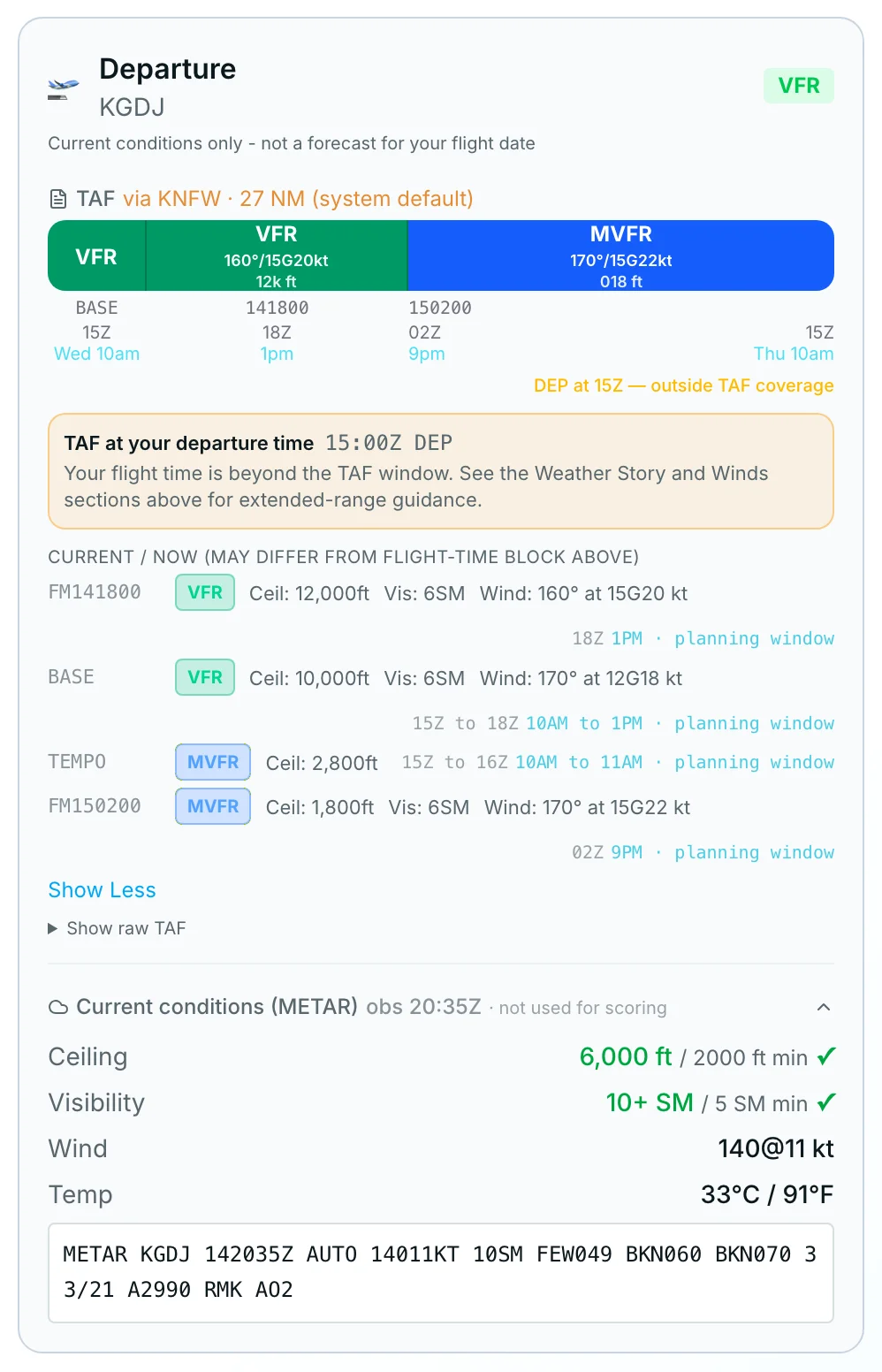
Scoring Categories & Maximum Deductions
Each weather category has a maximum deduction cap. No single factor can take more than its cap, and the system validates this server-side.
Route-coverage thunderstorm deductions and an en-route Convective SIGMET are assessments of the same air mass, so they're capped together in aggregate rather than added on top of each other: combined, en-route convective billing is limited to 40 points, but never below whichever single deduction is strongest, so a -50 Convective SIGMET alone still stays at -50, not -40. This applies only to en-route billing; a thunderstorm tied to your departure or arrival airport is a different air mass and is scored (and capped) on its own.
| Category | Max Points | When It Applies |
|---|---|---|
| Ceiling below minimums | -40 | Forecast ceiling at departure or arrival is below your hard limit |
| Visibility below minimums | -40 | Forecast visibility at departure or arrival is below your hard limit |
| Icing caution (no FIKI) | -2 to -10 | Trace, light or moderate icing within your tolerance, icing section rated caution, no FIKI. Sized by icing trap class (see FIKI Equipment below). Where the trap table does not apply (no trace, light or moderate icing in the canonical multi-model icing assessment, the icing section rated unfavorable, or another icing line already applies), the general icing caution can remain: -5 with the icing section rated caution, -10 with it rated unfavorable. It is dropped when the severe icing caution, an icing trap line or an icing line at least as large covers the same icing. On twin trips when the preflight check has not run, the general -5 can be added back after scoring, even where the table applies. |
| Icing (exceeds limit) | -15 to -50 | Severity exceeds your stated icing tolerance (even with FIKI) |
| Icing caution (FIKI) | 0 to -5 | Trace, light or moderate icing within your tolerance, icing section rated caution, FIKI equipped. Sized by icing trap class (see FIKI Equipment below). Where the trap table does not apply (no trace, light or moderate icing in the canonical multi-model icing assessment, the icing section rated unfavorable, or another icing line already applies), the general icing caution can remain: -5 with the icing section rated caution, -10 with it rated unfavorable, capped the same way. It is dropped when the severe icing caution, an icing trap line or an icing line at least as large covers the same icing. On twin trips when the preflight check has not run, the general -5 can be added back after scoring, even where the table applies. That re-added -5 is not capped by trap class, so a FIKI trip with no trap (cap 0) can still show -5. Severity derived from multi-model analysis (regional hi-res + GFS + ECMWF by geography) |
| Severe icing | -15 to -55 | Model-only severe icing is charged as a strong caution, not a hard stop: -55 when the CIP nowcast shows it, up to -25 from the IFI forecast, up to -15 from model consensus (HRRR, GFS, ECMWF). IFI and model-consensus icing lines share a pile cap (25 for IFI, 15 for consensus), so the severe line can be scaled lower when other lines from the same source deduct. Not limited by the trap-class icing cap below. Not a hard stop covers model sources only: a preflight check that fails on icing from a SIGMET, AIRMET, G-AIRMET or PIREP within 12 hours of departure still sets the score to 0%. |
| Warm nose + freezing rain (model soundings) | Unfavorable | An above-freezing layer over sub-freezing air, confirmed by corroborating evidence (the structure that produces freezing rain and freezing drizzle). FIKI approval does not cover SLD. The Appendix O certification basis is confined to transport-category aircraft, so assume yours is not approved unless its AFM says so. FIKI does not mitigate SLD. |
| SLD potential present (CIP/IFI) | -10 to -30 | Caution sized by how strongly large droplets are indicated, up to -30. The affected phase sets the bar for whether a reading counts (cruise is held to a higher bar than climb or descent). Requires at least light icing in the same layer. Applies to all aircraft regardless of FIKI. Product potential alone does not force a 0% (the field is an uncalibrated indicator, not a probability). |
| Thunderstorms | -40 | Forecast during your flight window (TAF TEMPO/FM/BECMG) |
| Convective SIGMET | -50 | Active convective SIGMET valid during your flight |
| Turbulence (exceeds limit) | -10 to -30 | Severity exceeds your stated turbulence tolerance |
| Turbulence (within limit) | -5 | Turbulence at or below your tolerance (caution only) |
| Crosswind | -15 | Server-calculated from TAF wind + runway data (when a TAF covers departure or arrival) |
| Crosswind, 12 to 72 h (NBM + MOS) | -10 / -15 | Worst crosswind within 2 h of your departure time or ETA and within 10 deg of the forecast direction, on the best aligned usable runway. Caution only, never a 0%. Details below the table. |
| Max ground wind, 12 to 72 h | up to -25 | Suggested value: steady wind above it costs 4 points per kt, up to 20. Gust at or above it: 5, plus 1 per kt above, up to 10. Your own Max Ground Operations Wind: steady wind or gust above it is a 25-point caution at that airport. Gust exactly at it: 5. With either value, steady wind exactly at it with no gust reported also costs 5. Trip total at most 40. At one airport, only the larger of this and a crosswind caution counts. The check is skipped when the MOS bulletin is out of date, and it needs soft or hard personal minimums set. Caution only, never a 0%. |
| Headwind impact | -5 to -15 | Flight time increased 15-25% (-5), 25-40% (-10), >40% (-15) |
| SIGMET (non-convective) | -15 | Active SIGMET along your route |
| G-AIRMET IFR (VFR trip) | 0% / -30 | An IFR G-AIRMET counts when its area comes within 25 NM of your route at the time you pass it. Today, on a VFR trip, that is a hard stop whether or not your route enters the area; when it does not, the briefing says so and gives the distance. PlaneWX measures the 25 NM to the nearest corner of the area. Exception: arrival only, when the arrival airport has its own (not proxy) TAF showing VFR at your ETA (including TEMPO and PROB groups), it becomes a -30 Marginal caution instead. From 25 to 50 NM it is a smaller caution of 15 to 25 points. |
| Mountain obscuration (VFR) | -50 | G-AIRMET Sierra MTN OBSCN directly on your VFR route |
| Approaching minimums | -10 | Ceiling within 500 ft or visibility within 1 SM of your limit |
| Wind shear | -10 to -20 | Graduated penalty based on your wind shear speed limits |
| Density altitude | 0* | Caution banner only (not a score ding). *Score hit only when runway performance criteria fail for types that run POH math (e.g. TBM 900) |
Crosswind and ground wind, 12 to 72 hours out
From more than 12 up to 72 hours before departure, PlaneWX scores crosswind at your departure and arrival airports from the NBM and GFS MOS surface wind forecasts. From 12 to 24 hours out, when a TAF is available for your departure or arrival airport, the TAF crosswind check runs instead of this one. This check needs both NBM and MOS wind for that hour, with their directions within 45 deg of each other. NBM uses the gust when one is forecast. MOS has sustained wind only.
- Worst case in time: PlaneWX reads every NBM hour within 2 h of your departure time (departure airport) or ETA (arrival airport), and the MOS forecasts that cover the same span.
- Worst case in direction: each forecast direction is also turned up to 10 deg each way, in 1 deg steps.
- Runway: for each of those winds, the crosswind is taken on the best aligned usable runway: not marked closed, not shorter than your aircraft's minimum runway length, and paved when your aircraft is set to paved runways only (the default). When two runway ends tie, the one with more headwind is used. The score uses the largest of these crosswinds.
- AFD gusts: when the Area Forecast Discussion states a gust range (for example "gusts 30-40 mph") and the NBM gust within 2 h (the NBM sustained wind when NBM has no gust) reaches the low end of that range, the high end of the range, in kt, is also checked on each model direction. When the AFD states the weather system does not reach the area, no crosswind caution is charged.
- Points: a crosswind at or above your comfort value and below your limit costs 15. At or above your limit it also costs 15, as a caution, not a 0%. With only a comfort value set, a crosswind at or above it costs 10. A crosswind below your comfort value costs 0.
- Deduction line: when the worst case is above the single forecast hour, the line names it, for example "Worst crosswind hour within 2 h of arrival and 10 deg of the forecast direction: NBM 320 deg gust 30 kt at 12 PM CDT (17Z), taken at 329 deg."
- Runway crosswind card: the card shows the forecast hour at your departure time or ETA. When a crosswind caution is charged at that airport, the card states the caution, its headline shows the charged value, and the card is not green.
Max Ground Operations Wind, 12 to 72 hours out. The check is skipped when the MOS bulletin is out of date. It needs soft or hard personal minimums set: VFR ceiling soft or hard; IFR departure ceiling soft or IFR arrival ceiling hard; aircraft IFR hard ceiling or visibility overrides; crosswind soft or hard (global only); turbulence, icing, icing exposure, or wind shear soft or hard (global or aircraft); or an airport override for departure or arrival. The check then uses your value, or the suggested value when the field is blank, against the wind at your departure time and ETA. A TAF valid at that time sets the wind. For the arrival, a nearby airport's TAF is used when the arrival airport has none. Without a TAF, sustained wind comes from MOS (NBM when MOS has none) and the gust is the strongest NBM gust within 2 h of your departure time (departure airport) or ETA (arrival airport). When no gust is forecast, the gust is taken as the sustained wind. A gust range from the AFD, matched by the NBM gust (or the NBM sustained wind when NBM has no gust) as above, replaces the model gust when it is higher. When the gust comes from another hour in that window, the ground wind line names that hour.
- Suggested value (field blank), steady wind above it: 4 points per kt over, up to 20.
- Suggested value, gust at or above it, with steady wind at or below it: 5 points at the value, plus 1 per kt above, up to 10. With a 30 kt value, a 30 kt gust costs 5, 31 kt costs 6, 33 kt costs 8, and 35 kt or more costs 10.
- Your own value, steady wind or gust above it: a fixed 25-point caution at that airport, not a 0%. Crosswind or gust crosswind points already charged there count toward the 25. With a 15-point crosswind caution there, the ground wind line shows -10. With a 25-point crosswind caution there, nothing is added.
- Your own value, gust exactly at it, with steady wind at or below it: not above it. It costs 5 points at that airport, less any crosswind points already charged there.
- Steady wind exactly at the value, suggested or your own, with no gust reported, is treated as a gust at the value: it costs 5 points at that airport, less any crosswind points already charged there.
- This range never sets the WX Score to 0%.
One wind charge per airport. When a crosswind caution and a ground wind line fall at the same airport, the larger one counts. The ground wind line adds only the points above the crosswind caution already charged there, and adds nothing when the crosswind caution is equal or larger. Ground wind points also stop when the wind lines at that airport reach 25 points in total, or 40 points of ground wind for the trip. On a flight that departs and lands at the same airport, ground wind is charged once.
Comfort vs. Limit (Soft / Hard Minimums)
PlaneWX uses a two-tier minimums system for graduated scoring:
Comfort (Soft Limit)
Your preferred conditions. Exceeding your comfort level puts you in the caution zone (yellow). The score penalty is proportional to how far into the zone you are.
Example: Ceiling comfort 2000 ft, limit 1000 ft. A 1500 ft ceiling is in the caution zone.
Limit (Hard Limit)
Your absolute maximum tolerance. Exceeding your limit is unfavorable (red). Within 12 hours, the score drops to 0%. Beyond 12 hours the 25% floor applies, unless a covering TAF wind-shear or crosswind hard limit is exceeded, a ceiling or visibility forecast is wholly below the limit while the departure or arrival ceiling comes from a TAF, METAR, GFS MOS, NBM or the pre-flight check, or en-route smoke is below your visibility limit (then 0%).
Example: Ceiling limit 1000 ft. A 900 ft ceiling is unfavorable.
At your limit = caution, not unfavorable. If you set your turbulence limit to "Moderate" and the forecast shows moderate turbulence at cruise, that's a -5 caution, not unfavorable. You set that limit because you accept it. Unfavorable only triggers when cruise conditions exceed your stated limit. Moderate bumps confined to climb or descent (cruise still within comfort) are a small residual caution, not a full cruise Moderate hit.
TEMPO / PROB / BECMG / FM time window. The group that covers your departure or arrival hour is still scored at its own severity (including soft points). FM/BASE at the exact scheduled instant still count. These four cases are not scored, and each skipped adverse group shows a 0-point caution naming the station, group, condition, and how far outside the window it sits: (1) any group that ends before your departure time, (2) any group that starts after your arrival time, (3) a departure-airport group that starts after you depart, and (4) an arrival-airport group that ends before you arrive. Proxy-TAF TEMPO groups are caution-only even when they cover the hour. This change can raise a score; it never lowers one.
Finished BECMG groups and ceiling or visibility. A BECMG group that has finished changing by your departure or arrival time is treated as the forecast from then on, until the next FM or BECMG group. While it is still changing, PlaneWX uses the worse of the old and new conditions.

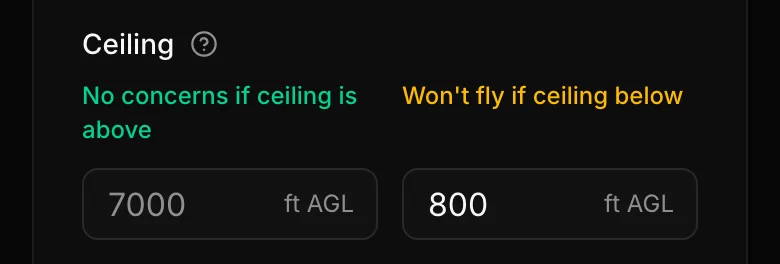
How Aircraft & Profile Affect Your Score
FIKI Equipment
Aircraft with FIKI (Flight Into Known Icing): when the icing section is rated caution for trace, light or moderate icing and no other icing line applies, the icing line is sized by the icing trap class (how much of the flyable altitude band the icing fills). Moderate: 0 with no trap, -3 partial trap, -4 severe trap, -5 full trap. Trace or light: 0, -1, -2, -3. If nothing else is deducted, the no-trap line is -2 (moderate) or -1 (trace or light). Severe icing is scored separately. Aircraft without FIKI: the same table without the FIKI halving. Moderate: -3 with no trap, -5 partial trap, -8 severe trap, -10 full trap. Trace or light: -2, -3, -4, -5. Whatever the section rating, the icing table, icing section and AI icing lines are capped together by trap class: without FIKI 10 with no trap, 20 partial, 35 severe, 50 full; with FIKI 0, 5, 15, 25. The icing exposure caution, the severe icing caution, SLD cautions and the model-hazard lines added when the score would otherwise be 100 are charged separately and are not limited by this cap. Neither is the general -5 icing caution that twin trips can add back after scoring when the preflight check has not run, so a FIKI trip with no trap (cap 0) can still show -5.
Aircraft Overrides
Aircraft-specific limits (crosswind, turbulence, icing) override your personal minimums. The more restrictive value always wins. Aircraft overrides are shown with a plane icon () in the Personal Minimums bar.
Flight Rules
VFR and IFR flights use separate ceiling/visibility minimums from your profile. VFR flights also check for IFR conditions and mountain obscuration (G-AIRMET Sierra) along the route. An IFR G-AIRMET within 25 NM of your route is a hard stop for VFR today, even when your route does not enter the area; if it covers only arrival and that airport's own TAF shows VFR at your ETA, PlaneWX applies a Marginal caution instead of zeroing the score. Departure and en route stay hard stops. From 25 to 50 NM it is a smaller caution.
What Does NOT Affect Your Score
PlaneWX is strict about only deducting for confirmed, product-backed conditions. These items are mentioned in your briefing for awareness but do not reduce your score:
- ✓Forecast uncertainty or distance to departure
- ✓Regional patterns without product confirmation (e.g., "gusty winds on ridges")
- ✓G-AIRMETs or SIGMETs that end before your flight
- ✓Old PIREPs that won't persist to departure time
- ✓Sky cover percentage alone (OVC does not mean a low ceiling without a height value)
- ✓Temp/dewpoint spread or fog risk (awareness only unless visibility is below minimums)
- ✓Thunderstorm mentions in WPC outlooks at 3+ days (scored as caution, not unfavorable)
- ✓Nearby airport reports near your destination. When you arrive within about 3 hours of the briefing and your destination has no TAF of its own, or its TAF doesn't show fog, mist, or IFR at your ETA, Ceilings & Visibility can list up to 2 airports within about 30 nm whose latest report (from the last 90 minutes) shows fog, mist under 3 SM, or IFR. For example: “KMIE, 13 nm, reporting 1/4 SM fog. Not scored.” These lines are a heads-up for your GO / NO-GO call and never change your WX Score.
Score Breakdown & Validation
- • Click Score Breakdown in your briefing to see exactly which factors are deducting points
- • Server-side validation ensures no single category exceeds its deduction cap
- • If a briefing section is marked "marginal" or "unfavorable" but has no matching deduction, the system adds one automatically
- • Section badges follow the score breakdown: the Icing badge is Favorable when the breakdown has no icing row, and the Ceilings & Visibility badge is Marginal only with a ceiling, visibility, IFR, IMC or obscuration row (including a TAF time-window caution at 0 points), the en-route smoke caution, a model-only IFR or LIFR ceiling, or a long-range watch (a ceiling or visibility hard minimum treated as a watch at this lead time, even when the 45-point caution cap leaves it at 0 points). The badges use the final score breakdown. An MVFR category alone is not Marginal. The PDF shows the same section badges as the app.
- • The WX Score is cross-checked against the Personal Minimums Check for consistency
- • For flights within 12 hours, the pre-flight check results take precedence over AI scoring
- • From 12 to 24 hours, TAF wind shear and crosswind server checks take precedence when a TAF covers that airport
- • Static runway length/surface fitness runs on every briefing (including beyond 12 hours) as a caution banner only: no WX Score floor or deduction for runway alone; weather-dependent checks stay time-gated and scored on the same schedule